by MOSES Publications | Jun 30, 2024 | Information, RJAC Racial Justice for All Children, Schools
MMSD Takes Important Steps for Student Literacy
By Barbie Jackson and Shel Gross, Racial Justice for All Children Task Force (RJAC) Education Advocacy Group
The Madison Metropolitan School District (MMSD)’s proposed budget for 2024-’25 contains a very significant statement:
In MMSD, we believe reading is a moral imperative for all students. Rooted in our commitment to ensuring all students graduate ready for college, careers, and the community, all students in MMSD will receive high-quality, grade-level accelerated instruction. Therefore, we are being very intentional about our commitment to early literacy and providing experiences that engage, challenge, and support all learners. This is THE priority work of our district moving forward.
The budget backs up this commitment with an investment of almost $2 million to provide 20 teachers at the K-1 level to reduce class sizes. With smaller class sizes, students will be able to engage at higher rates with grade-level rigorous standards-based learning and will receive direct and targeted skill instruction in small groups more often.
Because MMSD has already made a commitment to implementing the Science of Reading, which has an emphasis on phonics, the above statement aligns MMSD with RJAC’s issue proposal on addressing dyslexia. Indeed, in a recent conversation with Gabriela Bell Jiménez, Ph.Dl, the MMSD director of K-5 literacy, we learned that the district is moving ahead with a number of the requirements laid out in last year’s Act 20, and in some cases it is going beyond them.
- While the state Department of Public Instruction has not yet identified a universal screener for literacy, MMSD continues to use FastBridge to screen its students.
- The required diagnostic assessment (as opposed to the universal screening) is embedded in the curriculum that the district has purchased to implement the Science of Reading, so it is already in place.
- While implementation of personalized reading plans is required by January under Act 20, MMSD will be prepared to start in the fall. Also, Act 20 requires this only for English-only students, but MMSD will do it for bilingual students as well.
- MMSD is working on materials for informing parents and the community.
- A lawsuit between the governor and the legislature that is holding up the funding associated with Act 20 will not directly impact MMSD, because it will not need curriculum money until next year and doesn’t need literacy coaches. Each MMSD elementary school already has a full-time coach.
Dr. Bell Jiménez assured us that the new superintendent, Joe Gothard, is on board with all this.
RJAC’s Education Advocacy Group will be reaching out to partners to discuss strategies for advocating on behalf of the district’s literacy efforts.
by MOSES Publications | Apr 30, 2024 | Calls to Action, Information, MOSES activities, Newsletter, Organizer
Greetings, MOSES!
From Community Organizer James Morgan
Many of my recent experiences in the larger community have caused me to reflect on organizational capacity, recruitment, and leadership. Our goals and mission to establish a platform for collective power-building dictates that, as your organizer, I must reflect on MOSES and its capacity to build externally, as well as internally. Most recently, when I was talking with someone from another organization, our conversation focused on power and control versus leadership.
We recognized that, far too often, some very well-intentioned individuals can create tension within their organizations by operating from a mindset of power and control. We also noted that there are some fine lines that distinguish how leadership first and foremost must consider the well-being of the organization and the diversity of talents that make up the totality of the organization. The leadership must also recognize the contributions of all persons.
If these things are done, the organization thrives and is better positioned to impact and be of service to the community as a whole, to garner community support for its issues and actions, and to be seen and experienced as a leader in the quest for fairness, equity, and justice. Leadership also considers organizational tone in every communication. Tone and effective communication skills are the tools necessary for building collective power, consensus, and respect.
During my 25-plus years of incarceration, I was elected president of the African Culture Group and was the in-prison coordinator for the United Way Self-Help Program. I held many more positions, all of which allowed me to garner the insight and ability to understand organizational and group dynamics. Trust in our leadership, especially within a prison environment, is not easily acquired from administrators or other residents, or from external communities, to whom we are, for the most part, invisible.
Those experiences, coupled with my weeklong WISDOM Organizer Trainings, which are ongoing, have been pivotal in my ability to engage each of you as valued members of MOSES.This is what has taught me what leadership looks like. My fellow leaders, it is my hope that some of you will give deep consideration to participating in the weeklong Gamaliel training in Eau Claire, Wis., July 21-27, 2024. For further information, please feel free to contact me @ jm9461557@gmail.com
Let’s Do MOSES!
by MOSES Publications | Apr 30, 2024 | Advocacy, MOSES activities, Newsletter, Racial Equity, Racial Equity Team
MOSES Reaches In to Visit Black Churches
By Saundra Brown, President of MOSES
MOSES’s mission statement calls us to build collective power. This guiding principle, which comes directly from our national and statewide organizations, Gamaliel and WISDOM, is based on an understanding that we cannot achieve success without a broad, collaborative base.
To achieve our goals, we must build collective power. This requires us to develop organized people and organized money. We cannot close the gaps of economic, educational, and political inequalities, religious intolerances, and racial disparities alone.
We have celebrated our successes and learned from our mistakes, but, more importantly, we never give up; we stay in the fight. Month after month, we come together to be informed and engaged and to seek various opportunities to improve and to grow.
However, I can’t help but ask myself, “Where are the Black folks?” I have been a member of MOSES since 2018, and I have always wondered why this great organization is fighting against the issues that impact my people the most. Why aren’t my people more visible? What must we (MOSES) do to engage them in our work? I have come to the conclusion that it’s time to get radical. We must take a different approach to recruiting African American members.
We continue to reach out to seek new members to join MOSES. That approach is good, but now it’s not good enough. The time has come for us to not only reach out but also to make an effort to reach in, by visiting our African American churches.
When I presented this idea to MOSES leadership, they fully endorsed my recommendation to call on the members of each MOSES task force, committee, focus group, and team to select representatives who will commit to choosing a Sunday to visit an African American church as a group. With the assistance of James Morgan, our community organizer, we are reaching out to the African American church pastors to schedule monthly dates to visit each church. As these dates are confirmed, we are providing a schedule for each MOSES group to sign up for one visit. It would be most impressive if we go as a group of five to ten MOSES members each month. James and I will accompany each group on their visits.
During our visits we will share with the congregations:
- ● who we are and what we do
- ● extend an invitation to join the organization
- ● gift them with informational folders and yearbooks
- ● inspire them to start a Justice Group
The Executive Committee took the lead on this new approach by meeting at St. Paul African Methodist Episcopal Church in April. We had nine MOSES members in attendance, and our presence was extremely well received.
We look forward to further connection with St. Paul’s members and with other churches, to be scheduled soon. Watch for future reports in upcoming newsletters.
by MOSES Publications | Apr 30, 2024 | Advocacy, Newsletter, Prisons
What’s Happening to Parole in Wisconsin?
By Sherry Reames
The figures on the Parole Commission website show a huge recent drop in the number of paroles being granted. Between 2019 and 2022, an average of 167 individuals a year were released on parole. In 2023 the number plummeted to 37 (or 40, if we count those whose cases were heard in 2023 and added on the website in January and February 2024). The number so far in 2024 (as of April 20) is just one.
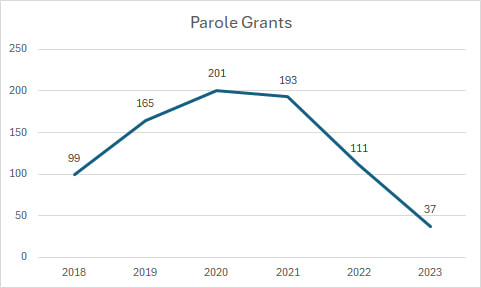
That is a shocking development, especially at a time when our prisons are dangerously overcrowded as well as understaffed. What in the world is going on?
Some basic points about parole and recidivism
- The only prisoners eligible for parole in Wisconsin are those whose crimes occurred before our 1999 truth-in-sentencing laws went into effect.
- Many of these prisoners were sentenced as juveniles or very young adults under the “tough on crime” policies of the Clinton administration. By now, 25 or 30 years later, they are mature adults. The possibility of parole has given them an incentive to continue their education, acquire job skills, and turn their lives around. If they have used their time in prison well, don’t they deserve a second chance?
- Statistically, mature individuals released on parole are very unlikely to commit another crime.
- According to The Sentencing Project, 20 years is a long enough sentence for most serious crimes. Incarcerating people longer than that may satisfy our desire for retribution, but it doesn’t add to their rehabilitation, and it doesn’t improve public safety.
- WISDOM believes that our state spends far too much money on prisons, money that could better be re-invested in education, child-care, public-health, and crime-prevention programs. As taxpayers, we should object in particular to the unnecessary incarceration of men and women who could be safely out in the community – earning a living, helping to support their families, and contributing to their communities and the workforce.
A year ago, the WISDOM workgroup on Old Law/Parole optimistically believed that the governor might be ready to re-establish the humane Wisconsin tradition of commuting the sentences of some prisoners who had received extreme sentences and served their time exceptionally well. Making such prisoners eligible for parole in the near future seemed like a good idea at that time, but with the parole system apparently frozen, it now sounds like a cruel joke.
WISDOM’s developing response to this setback.
So far, the Parole Commission has been resisting our inquiries, but we hope to have a meeting before long with the current chair, Jon Erpenbach. Our guess is that the Commission may still be reeling from the conservative backlash in 2022 against the attempt to release Douglas Balsewicz, which resulted in the firing of John Tate II and the legislature’s adoption of two new laws in 2023, Acts 31 and 230, which add further requirements to the parole process.
Besides trying to meet with Erpenbach, the Old Law/Parole workgroup is planning a community forum specifically focused on parole and commutation, probably to be held in Milwaukee in early June. Our goal is to create more public awareness of how the parole process is supposed to work, the advantages of enabling prisoners to earn a second chance by this means, and the unnecessary suffering we inflict on both incarcerated people and their families when we forget about their humanity and focus only on the victims of crime. Three MOSES members are already involved in this effort (Amanda Johnson, Kay Stevens, and I), and it would be wonderful to have many other participants from this part of the state. Please watch for future announcements about the forum. Plan to join us if you can, and bring some of your neighbors!
by MOSES Publications | Apr 30, 2024 | Life After Prison, Newsletter, Reviews
Film Review: The 50 Is Changing Lives
By Margaret Irwin
The 50 is the story – set in California – of a unique way to give incarcerated people a second chance: by training them to become addiction counselors. In March, EXPO sponsored a showing of this documentary at the Urban League’s handsome new Black Business Hub on South Park Street.
In 2006, the federal government decreed that California must reduce its prison population by 50,000 to relieve overcrowding. At that time, more than 85% of prison residents were involved in drug use. In response, and for the first time, the state legislature budgeted money specifically for rehabilitation. This funding enabled some determined individuals to introduce an offender/ mentor certification program for 50 residents of Solano State Prison.
The program was met with suspicion to start with, but the positive impact it had on participants eventually persuaded many others to join. The program has since spread to other California prisons, and other groups of 50 have had the opportunity to turn their lives around, proving the truth of The 50’s motto: “There is life after death.”
What makes “The 50” program so effective is that in order to become addiction counselors, the men have to deal with their own selves first. This involves looking deep within to review the traumas from their past, examine their core beliefs, and identify the roadblocks that keep them from moving forward. They not only have to answer these questions for themselves; they also have to share them with the others in the group. Some brave men allowed themselves to be filmed telling their stories, in the hope of encouraging others. As one noted: “We are experts in the field when it comes to loneliness, fear, and pain.”
At the conclusion of the film, a panel of people with lived experience, including James Morgan, shared their reactions. As one participant noted, if the world shows you you’re not worth anything, it’s vitally important to be part of a community that tells you otherwise. The panelists pointed out that similar deep trauma work is now happening in Wisconsin prisons. It took some 20 years to get the Department of Corrections to allow the training of peer-support specialists to work in the prisons. Having relatable mentors has made a huge difference, one panelist said.
The speakers agreed that family plays a crucial role in the fate of young people. An unhealthy family is very hard to break away from; young people often turn to gangs as a substitute for the community they miss at home. Therefore, it is imperative to invest in families before children find themselves on the road to incarceration. One recommended model for youthful offenders is an academy run by counselors with lived experience. The youth are given everything they need – food, housing, therapy, skills training, and, most importantly, love. They are seeking what we all need: a sense of worth and value.
You can find a link to view the film at the50film.com.
