by Pamela Oliver | Jul 27, 2026 | Life After Prison, Policing
We are sharing this infographic by EXPO (Ex-Incarcerated People Organizing) because we believe it makes some important points and is worth sharing with others as part of educating the community, but it is not an official MOSES statement. For those with screen readers, the text of the poster is given below.
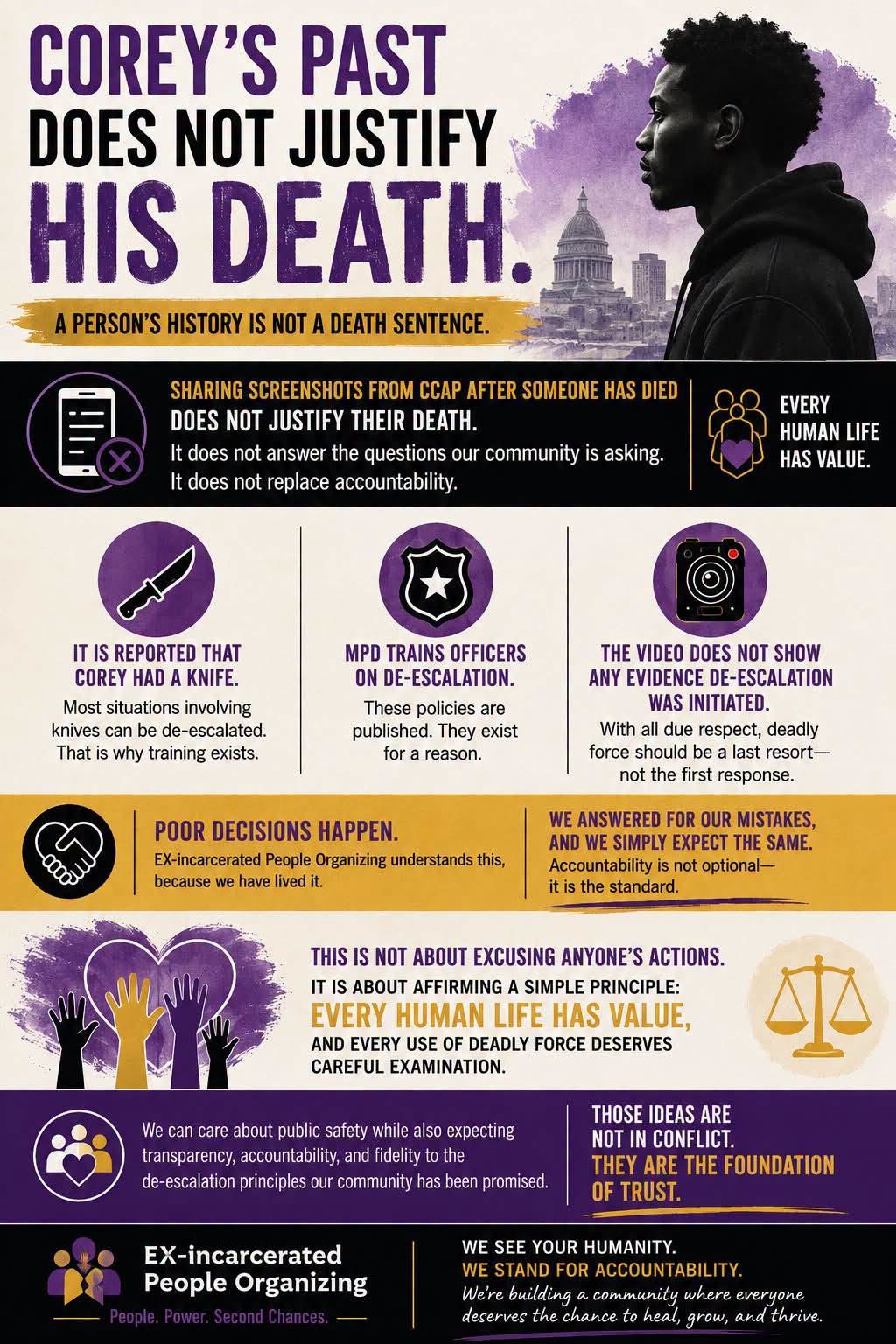
Poster created by Ex-Incarcerated People Organizing
Text of poster:
Corey’s past does not justify his death. A person’s history is not a death sentence. Sharing screenshots from CCAP after someone has died does not justify their death. It does not answer the questions our commuity is asking. It does not replace accountability. Every human life has value.
IT IS REPORTED THAT COREY HAD A KNIFE. Most situations involving knives can be de-escalated. That is why training exists.
MPD TRAINS OFFICERS ON DE-ESCALATION. These policies are published. They exist for a reason.
THE VIDEO DOES NOT SHOW ANY EVIDENCE DE-ESCALATION WAS INITIATED. With all due respect, deadly force should be a last resort-not the first response.
POOR DECISIONS HAPPEN. EX-incarcerated People Organizing understands this, because we have lived it.
WE ANSWERED FOR OUR MISTAKES, AND WE SIMPLY EXPECT THE SAME. Accountability is not optional-it is the standard.
THIS IS NOT ABOUT EXCUSING ANYONE’S ACTIONS. IT IS ABOUT AFFIRMING A SIMPLE PRINCIPLE: EVERY HUMAN LIFE HAS VALUE, AND EVERY USE OF DEADLY FORCE DESERVES CAREFUL EXAMINATION.
We can care about public safety while also expecting transparency, accountability, and fidelity to the de3-escalation principles our community has been promised. These ideas are not in conflict. They are the foundation of trust.
Ex-Incarcerated People Organizing. We see your humanity. We stand for accountability. We’re building a community where everyone deserves the chance to heal, grow, and thrive.
by Pamela Oliver | Jul 23, 2026 | MOSES leadership, Policing
MOSES Statement about the Killing of Corey Ruiz
July 23, 2026
by Saundra Brown, MOSES President
MOSES grieves the killing of Corey Ruiz by a Madison police officer, who shot and killed him on July 22 in broad daylight on Williamson Street in Madison. We lift up our prayers and support for the family, friends and neighbors of Mr. Ruiz and for the impact on the community, which once again is suffering the traumatic killing of a Black man at the hands of police.
We call on the Madison Police Department to fully investigate and disclose the circumstances of this tragic loss of life. We call for full adherence to use of lethal force policies, de-escalation training, enforcement of the practices called for by these policies and training, and evaluation of reforms needed to protect all members of our community from unnecessary violence and use of lethal force by MPD. And we call for full police transparency and accountability for the death.
We commit to continue our efforts to understand, support, and advocate for systemic improvements in local, statewide, and national policies to reduce the use of lethal force. MOSES will continue to focus our advocacy work on the local and State of Wisconsin standard operating procedures and the realities of training and adherence to policy by local law enforcement.
We call on MPD to abide by policies pertaining to use of force and de-escalation practices and to hold officers accountable, especially when it involves killing members of our society. Further, we fully support the Office of the Independent Police Monitor in their investigation of this killing and urge the police chief to cooperate fully with their investigation. We also call on the Madison Common Council to fully support the OIPM independence and funding as currently provided by Madison Ordinance. This tragedy underscores the need for an independent police monitor and civilian oversight board.
May Corey Ruiz rest in peace and may justice prevail in the aftermath of his tragic loss of life.
by Pamela Oliver | Oct 25, 2025 | Criminal Legal System, JPTF Justice & Police TF, Policing
MOSES and its Justice and Policing Task Force support the Independent Police Monitor and the Citizen Police Oversight Board (PCOB) as they are undergoing transition after the recent resignation of the Independent Monitor. The MOSES co-sponsored a Zoom interview organized by the Community Response Team with experienced Independent Monitor Joseph Lipari. He discussed the qualifications needed for an Independent Monitor and best practices for having an effective IM.
Here is a link to a recording of this conversation.
by Pamela Oliver | Oct 22, 2025 | Criminal Legal System, JPTF Justice & Police TF, Policing
Representatives of Madison’s Police Citizen Oversight Board held a listening session on October 22. MOSES members were present to ask questions and make comments. Here is a link to a video recording of that session. Note that the session was optimized for the in-person attendees so the recording is only so-so.
by Pamela Oliver | Nov 18, 2023 | Calls to Action
Want to help spread the news about all the great things happening in MOSES?
Join the MOSES Communications Team!
We work behind the scenes to help MOSES members carry out their work of ending mass incarceration and mass supervision and eradicating the racial disparities in our community that contribute to them. We do this through a bi-monthly newsletter and an annual yearbook.
People who serve on the newsletter/yearbook team enjoy writing, keeping people informed, and working with a small group to accomplish this task. The skills we have as a group include writing, editing, proof-reading, recruiting other writers, and keeping track of what’s going on in the community.
We also want to amplify our presence on social media platforms – Twitter, Facebook, X, and You Tube. We’re looking for people skilled in using social media who want to help with our mission.
If you think you might be interested in joining the newsletter group or the social media group, get in touch with Margaret Irwin at mbirwin@charter.net .
