
Madison Organizing in Strength, Equity, and Solidarity
for Criminal Legal System Reform

Commutations Campaign Update

Commutations Campaign Update,
by Sherry Reames
On April 3 (Good Friday) Governor Evers announced the beginning of a new commutation process that will allow some prisoners in Wisconsin to shorten the remainder of their time behind bars. To implement this process, the governor is creating a Commutation Advisory Board, and his office immediately published new application forms and requirements for two kinds of candidates: juvenile lifers (people who received life sentences as teenagers) and people convicted at age 20 or more.
Although the governor’s announcement provided the WISDOM Old Law workgroup with a very happy Easter weekend, it did not mean that our three-year campaign for commutations has reached its goals. We are grateful to have come this far, but no prisoners have actually benefited yet. The governor and his advisors haven’t made the really hard choices yet. Furthermore, their new application process gives prisoners and their advocates an enormous amount of work to do and not much time to do it, since Evers’ term will end in December and the next governor may not choose to keep this little window of opportunity open.
The leader of WISDOM’s campaign, Beverly Walker of MICAH, was working with the governor’s staff long before this announcement to provide them a model application and selection process for commutations, based on the systems used in other states. But they ultimately scrapped her suggestions in favor of a “uniform application process” that closely follows Wisconsin’s existing application process for pardons. They seem not to have realized how much harder it would be for incarcerated applicants to obtain the certified legal documents required for this application (given the DOC’s insistence on shredding original documents and substituting photocopies), answer the questions that require internet searches, and pay for all the necessary photocopying and postage. So Beverly Walker was back on the phone with the governor’s office many times in April, negotiating work-arounds for the most cumbersome requirements. The latest revision of the Commutation requirements can be found on the Resources page of her website, theintegritycenterwi.org, and under FAQs on the governor’s site.
Since the governor’s office is requiring all commutation applicants to start over, using the new process, Wisconsin advocates for prisoners are now hard at work, trying to help candidates complete their applications, together with the required legal documents and as many supporting materials as possible, and submit all this paperwork to the governor’s office (with copies to the DA and the Clerk of Courts in the county of their conviction) as soon as possible. Leaders of EXPO, the Community, Justice Forward, and other nonprofits are calling for more volunteers to help, and WISDOM Old Law could use more volunteers too. Since the new process opens the door to a much larger population than the Old Law prisoners we originally had in mind, there is likely to be an enormous crush of applicants, all racing to take advantage of this opportunity before it vanishes.
The other big need right now is a public education campaign, trying to preserve the possibility of a second chance for as many deserving candidates as possible. Already politicians have started announcing their opposition to even considering the cases of those convicted of certain kinds of crime. Gov. Evers’ office has ruled out clemency for anyone convicted of a sex crime. Wisconsin Watch has reported that two of the candidates to succeed Evers (Tom Tiffany and Mandela Barnes) would also oppose commutations for anyone convicted of murder. Such blanket exclusions would rule out the possibility of a second chance for many of the people who are serving the longest sentences in our prisons, no matter how completely they have reformed and how much they have accomplished since the time of their crime.
Because stoking fears and prejudices about “violent criminals” often succeeds in political campaigns, those of us who know more should counter such tactics with real-life facts and examples. When members of the Old Law workgroup evaluated the records of potential applicants for commutation, we found that many of the strongest candidates were serving very long sentences for “first-degree intentional homicide,” either alone or as parties to the crime. Very few of their crimes resembled the media image of first-degree murder, however. Instead, at the time of conviction the typical candidate in this group was a teen or very young adult who did not plan to kill anybody but impulsively over-reacted out of anger or fear. Sometimes they were trying to protect themselves or someone else. Some were abuse victims who fought back against their abusers. A few seem to have played only a small part in a crime committed by others. But it was the “tough on crime” 1990s when most of these young folks came to trial, and they were prosecuted to the full extent of the law. Their original judges failed to make allowances for their youth and recognize their potential for redemption, but now we have a rare opportunity to rectify that injustice. Let’s not waste it!
What’s Happening to Parole in Wisconsin?

What’s Happening to Parole in Wisconsin?

By Sherry Reames


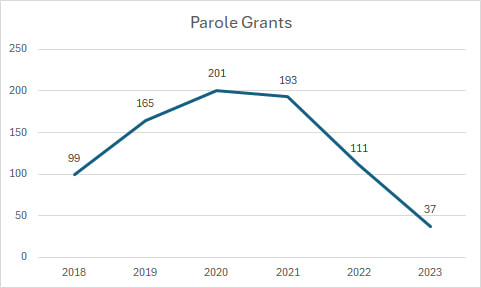
The figures on the Parole Commission website show a huge recent drop in the number of paroles being granted. Between 2019 and 2022, an average of 167 individuals a year were released on parole. In 2023 the number plummeted to 37 (or 40, if we count those whose cases were heard in 2023 and added on the website in January and February 2024). The number so far in 2024 (as of April 20) is just one.

That is a shocking development, especially at a time when our prisons are dangerously overcrowded as well as understaffed. What in the world is going on?

Some basic points about parole and recidivism


  • The only prisoners eligible for parole in Wisconsin are those whose crimes occurred before our 1999 truth-in-sentencing laws went into effect.


  • Many of these prisoners were sentenced as juveniles or very young adults under the “tough on crime” policies of the Clinton administration. By now, 25 or 30 years later, they are mature adults. The possibility of parole has given them an incentive to continue their education, acquire job skills, and turn their lives around. If they have used their time in prison well, don’t they deserve a second chance?


  • Statistically, mature individuals released on parole are very unlikely to commit another crime.


  • According to The Sentencing Project, 20 years is a long enough sentence for most serious crimes. Incarcerating people longer than that may satisfy our desire for retribution, but it doesn’t add to their rehabilitation, and it doesn’t improve public safety.    


  • WISDOM believes that our state spends far too much money on prisons, money that could better be re-invested in education, child-care, public-health, and crime-prevention programs. As taxpayers, we should object in particular to the unnecessary incarceration of men and women who could be safely out in the community – earning a living, helping to support their families, and contributing to their communities and the workforce.


A year ago, the WISDOM workgroup on Old Law/Parole optimistically believed that the governor might be ready to re-establish the humane Wisconsin tradition of commuting the sentences of some prisoners who had received extreme sentences and served their time exceptionally well. Making such prisoners eligible for parole in the near future seemed like a good idea at that time, but with the parole system apparently frozen, it now sounds like a cruel joke.


WISDOM’s developing response to this setback.


So far, the Parole Commission has been resisting our inquiries, but we hope to have a meeting before long with the current chair, Jon Erpenbach. Our guess is that the Commission may still be reeling from the conservative backlash in 2022 against the attempt to release Douglas Balsewicz, which resulted in the firing of John Tate II and the legislature’s adoption of two new laws in 2023, Acts 31 and 230, which add further requirements to the parole process.


Besides trying to meet with Erpenbach, the Old Law/Parole workgroup is planning a community forum specifically focused on parole and commutation, probably to be held in Milwaukee in early June. Our goal is to create more public awareness of how the parole process is supposed to work, the advantages of enabling prisoners to earn a second chance by this means, and the unnecessary suffering we inflict on both incarcerated people and their families when we forget about their humanity and focus only on the victims of crime. Three MOSES members are already involved in this effort (Amanda Johnson, Kay Stevens, and I), and it would be wonderful to have many other participants from this part of the state. Please watch for future announcements about the forum. Plan to join us if you can, and bring some of your neighbors!

MOSES Sentencing Forum April 2021

This Zoom event includes many speakers about sentencing in Dane County. It includes informative presentations followed by a Q&A with judicial candidates.

Part 1 is two hours. Speakers include Marquette Law Professor Michael O’Hear, UW Madison Law Professor Cecelia Klingele, Dane County District Attorney Ishmael Ozanne, State Public Defender Catherine Dorl , Judge Nicholas McNamara, people who have been incarcerated, and MOSES members.

YouTube Link

Part 2 continues the discussion. It is 1:25 long. It includes statements by many different people who are judges or candidates for judge who were asked to answer specific questions about sentencing after hearing the earlier presentations.

YouTube Link

Learn more about Old Law Parole #ReformNow #ReformWisDOCNow @Wisdom4Justice

In Wisconsin, more than 2,800 men and women remain incarcerated, even though they are legally eligible for parole under the terms of their original sentences. Their continued incarceration costs the state more than 96 million each year. All of these inmates were sentenced prior to the enactment of the Truth In Sentencing legislation. Consequently, many were given longer sentences with the expectation that they could be released after 25 percent of their time had been served. At this point in time, many have completed their required programs, have solid release plans, have all been incarcerated for more than 25 percent of their sentence, and many even work in the community with little to no daily supervision. Still, they are continually told that their release would impose an unreasonable risk to the public and that they have not served enough time. It is time for the Governor, the Department of the Corrections, and the Parole Commission to fix this broken, ineffective, and very expensive system, allowing these men and women to return to their families and become productive members of our society.